
Flow Wrappers — The Complete B2B Guide
25+ articles on selection, operation, maintenance and troubleshooting for packaging engineers.
In horizontal flow wrapping, the end-seal and cut-off system is arguably the most critical subsystem on the machine. It simultaneously performs two essential functions: creating an airtight seal at both ends of each package and separating individual packages from the continuous film web. The seal technology you choose—hot knife or rotary cut-off—directly affects package appearance, seal integrity, production speed, and maintenance costs.
Despite its importance, seal technology selection is often treated as an afterthought during equipment specification. This article provides a thorough technical comparison of hot knife and rotary cut-off sealing to help packaging engineers, quality managers, and production leaders understand the trade-offs and make informed decisions.
Key Takeaways
Quick answer: Hot knife cut-off seals and cuts in one step for heat-sealable films; rotary cut-off cuts cold and clean at higher speeds — film type and speed decide which fits.
- Two technologies, one job — hot knife seals-and-cuts; rotary knife cuts mechanically
- Seal quality differs — hot-knife edges are sealed; rotary edges stay open where film allows
- Film compatibility rules — heat-sealable laminates suit hot knife; sensitive films suit rotary
- Dual-technology machines exist — some lines switch methods per product
How Each Technology Works
One clarification first: heating and blade motion are two separate choices. A machine can heat-seal with one set of jaws and cut with a cold knife; the knife itself can move rotary or reciprocating. In this article “hot knife” means a heated blade that seals and cuts in one action, and “rotary cut-off” means a rotating knife working alongside a separate sealing unit. Those are the two configurations most buyers actually choose between — just don’t read the names as “heated vs. rotating”.
Hot Knife Sealing
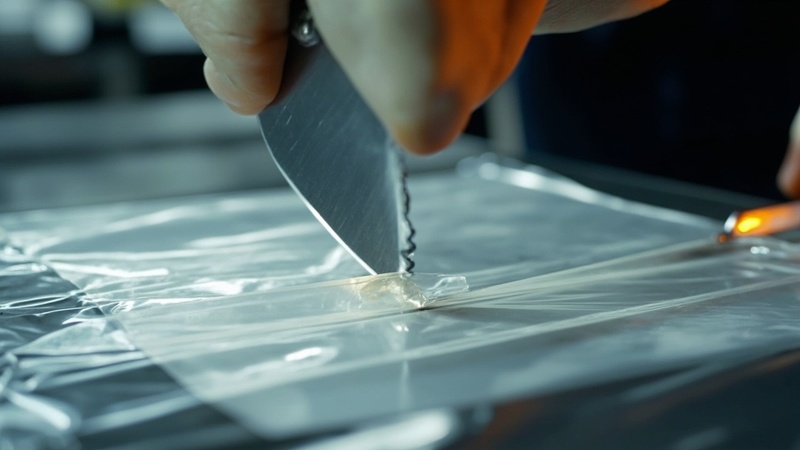
A hot knife seal system uses a heated metal blade (the “knife”) mounted between two sealing jaws. The knife heats to a controlled temperature—typically 150–250°C depending on film composition—and simultaneously cuts through the film while the sealing jaws press the film edges together to form the end seal.
The process occurs in a single, rapid action:
- The sealing jaws close on the film web
- The hot knife blade contacts the film between the two packages
- The blade melts through the film while the jaws simultaneously seal the outer edges
- The jaws open, releasing the separated packages
- The cut edge is sealed (fused) by the residual heat from the cutting process
The result is a clean-cut package end with a fused seal that is both hermetic and aesthetically clean. The cut edge itself becomes a seal, eliminating the possibility of film delamination at the cut line.
Rotary Cut-Off Sealing
A rotary cut-off system uses a pair of rotating drums or wheels equipped with sealing surfaces and cutting elements. One drum carries the sealing and cutting elements (the “male”), while the other provides the anvil surface (the “female”). As the drums rotate, they continuously seal and cut the film in a pinching motion.
There are several rotary cut-off configurations:
- Crimped seal with separate cut: The sealing drums crimp the film to form the seal, and a separate cutting blade (or perforating wheel) cuts through the crimped area
- Seal-and-cut combined: A single rotary jaw both seals and cuts in one operation
- Perforated cut-off: Instead of a full cut, a perforated line is created, allowing consumers to tear packages apart (common for multi-packs)
Rotary cut-off systems operate in continuous motion, matching the continuous film feed of high-speed flow wrappers. There is no stop-start cycle; the film is sealed and cut as it passes through the rotating drums.
Seal Quality cut-off knife adjustment guide Comparison
Hermetic Seal Integrity
Both technologies can produce hermetic seals suitable for food, pharmaceutical, and medical device packaging. However, the mechanism of seal formation differs:
Hot knife seals are formed by the simultaneous action of heat melting and jaw pressure. The heated blade creates a fused seal zone at the package end, with the cut edge itself being sealed by residual heat. This produces a seal with:
- Complete edge fusion (no unsealed film edges)
- Consistent seal width determined by jaw overlap
- Strong burst strength, typically exceeding 15 N/15mm for standard BOPP films
- Excellent resistance to peel forces due to the full-width fused edge
Rotary crimp seals are formed by pressure and heat applied by the rotating drum surfaces. The seal integrity depends on:
- Drum temperature uniformity across the sealing surface
- Contact pressure consistency
- Dwell time (determined by drum diameter, rotation speed, and contact arc)
For most standard packaging films, both technologies produce seals that exceed industry requirements. However, hot knife seals have an advantage with multi-layer barrier films because the cutting heat penetrates all layers simultaneously, ensuring a complete seal through the entire film structure.
Package Appearance
Hot knife package ends feature:
– A clean, straight cut edge with fused appearance
– No crimp pattern or embossing (unless crimping jaws are used in combination)
– Consistent package length with minimal variation
– Professional, premium appearance suitable for retail packaging
Rotary cut-off package ends feature:
– A crimped or patterned seal area (the degree of crimp depends on drum surface design)
– Possible slight variation in package length due to continuous-motion cutting
– Crimped ends can provide a useful grip point for consumers opening the package
– Slightly wider seal area compared to hot knife
For premium consumer products where package aesthetics directly impact shelf appeal—such as chocolate bars, cosmetic items, or pharmaceutical products—hot knife sealing is often preferred. For products where the crimped end serves a functional purpose (easy-open grip point) or where a traditional appearance is expected, rotary crimping may be the better choice.
How Do You Handle Speed and Throughput?
Hot Knife: Intermittent Motion Speed Limitation
Hot knife sealing operates in intermittent motion. The machine must momentarily pause (or significantly decelerate) during the seal-and-cut cycle to allow the hot knife to complete the seal and cut before the jaws open and machine motion resumes.
This stop-start nature limits hot knife systems to speeds of approximately 40–250 packages per minute, depending on product length and machine design. Longer packages require more time for the film to index forward, which proportionally reduces maximum speed.
Related: Troubleshooting Heat Sealing Issues: Seal Strength
Advanced hot knife systems with optimized jaw mechanisms can approach 300 ppm, but beyond this threshold, the physical limitations of intermittent sealing become prohibitive.
Rotary Cut-Off: Continuous Motion Speed Advantage
Rotary cut-off systems operate in continuous motion, which eliminates the speed limitation imposed by intermittent stopping. The rotary drums rotate continuously, sealing and cutting the film as it passes through without interruption.
This enables rotary systems to achieve speeds of 200–1,200 packages per minute, with high-speed models commonly operating at 400–600 ppm. The continuous-motion design is essential for any application requiring sustained high-speed production.
| Parameter | Hot Knife | Rotary Cut-Off |
|---|---|---|
| Motion Type | Intermittent | Continuous |
| Speed Range | 40–250 ppm | 60–1,200 ppm |
| Max Practical Speed | 300 ppm | 1,200+ ppm |
| Seal Dwell Time | 0.3–1.0 seconds | 0.05–0.2 seconds |
| Best Speed Sweet Spot | 60–150 ppm | 200–500 ppm |
What Affects Film Compatibility?
Hot Knife Film Compatibility
Hot knife systems work with a broad range of heat-sealable films, including:
- BOPP (Biaxially Oriented Polypropylene) — the most common flow wrapping film
- CPP (Cast Polypropylene)
- PE (Polyethylene) — LDPE, LLDPE
- PET/PE laminates
- Aluminum foil laminates
- Complex multi-layer barrier films (up to 7–9 layers)
The hot knife approach is particularly effective with thicker films (80–150 microns) and multi-layer structures because the cutting action ensures complete penetration through all layers. For films containing aluminum foil or EVOH barrier layers, hot knife provides reliable seal-through capability.
Hot knife systems are generally not compatible with cold-seal films (adhesive-coated films that seal without heat), as the cutting heat can damage the cold-seal adhesive.
Rotary Cut-Off Film Compatibility
Rotary systems work with similar film types choosing the right flow wrapper but have different strengths:
- Excellent with standard BOPP and PE films
- Well-suited for thinner films (20–60 microns) where the gentle crimping action prevents tearing
- Compatible with cold-seal films when equipped with unheated or low-temperature drums
- Effective with printed films where the crimp pattern enhances seal security
Rotary systems can struggle with very thick films or heavy-duty barrier laminates because the crimping action may not generate sufficient seal pressure through the full film thickness. For films above 120 microns, hot knife is generally the more reliable choice.
Special Film Considerations
Shrink films: Both technologies can handle shrink films, but hot knife provides cleaner cuts through the heavier shrink materials commonly used for multi-pack wrapping.
Biodegradable films: PLA and other biodegradable films have lower heat resistance than conventional films. Rotary systems with lower sealing temperatures may be preferable to prevent film damage during sealing.
Reclosable films: Films with resealable adhesive strips or zipper closures require specialized handling that may favor one technology over the other depending on the specific reclosure design.
How Do You Handle Maintenance and Wear?
Hot Knife Maintenance
Hot knife systems require regular attention to maintain seal quality:
- Blade replacement: Hot knife blades wear over time due to contact with film and abrasive fillers. Typical replacement interval is every 3–6 months at high-volume production, with blades costing $50–$200 each
- Jaw surface maintenance: Teflon-coated or PTFE-covered jaw surfaces wear and must be periodically replaced to prevent film sticking
- Temperature calibration: Heating elements require periodic calibration to ensure accurate and consistent seal temperatures
- Cutting edge inspection: The knife edge must remain sharp for clean cuts; dull blades produce ragged edges and incomplete seals
Rotary Cut-Off Maintenance
Rotary systems have different maintenance requirements:
- Drum resurfacing: Rotary sealing drums experience wear and require periodic resurfacing (regrinding) to maintain seal quality. Typical interval is 12–18 months
- Bearing maintenance: Rotary drum bearings require regular lubrication and inspection
- Timing adjustment: Drum-to-drum timing must be maintained for consistent seal and cut position
- Cutting element replacement: Cutting blades or perforating wheels wear and require periodic replacement
Overall, rotary systems tend to have lower routine maintenance costs on a per-package basis because the rotary drums have a longer service life between resurfacing events compared to hot knife blade replacement intervals. However, when maintenance is required, rotary drum resurfacing is more complex and expensive than simply replacing a hot knife blade.
How Do You Handle Application Decision Guide?
Choose Hot Knife When:
- Package appearance is paramount: Premium consumer products where clean, straight-cut ends are expected
- Barrier film sealing is required: Multi-layer films with EVOH, PVDC, or aluminum foil where complete seal-through is essential
- Production speed is moderate: Operations running below 200 ppm where intermittent motion is not a limitation
- Thick films are used: Films above 80 microns where hot knife cutting provides cleaner separation
- Pharmaceutical or medical device packaging: Applications requiring validated hermetic seals with complete edge fusion
At Path Pack, our standard flow wrappers equipped with hot knife sealing are widely used in pharmaceutical applications, including transdermal patch packaging and medical device overwrapping, where seal integrity and package aesthetics are critical compliance requirements.
Choose Rotary Cut-Off When:
- High speed is essential: Production requirements above 250 ppm where continuous motion is necessary
- Crimped seal appearance is acceptable or preferred: Products where the traditional crimped-end look is expected by consumers
- Cold-seal films are used: Chocolate and confectionery products where heat-sensitive cold-seal coatings are standard
- Thin films are standard: Operations primarily using 20–60 micron films where rotary crimping provides better handling
- Multi-pack applications: Perforated cut-off is needed for tear-off convenience in multi-pack formats
What Cost Considerations Should You Evaluate?
Equipment Cost
Assembly-level costs are quoted with the machine configuration — request both options when comparing.
The rotary premium reflects the precision engineering required for continuous-motion sealing drums, including CNC-machined sealing surfaces, precision bearings, and temperature control systems.
Operating Costs
| Cost Factor | Hot Knife | Rotary Cut-Off |
|---|---|---|
| Energy consumption | Moderate (heating elements) | Moderate (drum heaters) |
| Downtime for maintenance | Higher (frequent blade changes) | Lower (infrequent drum service) |
The operating cost difference is modest and highly dependent on production volume and film type. For most operations, the seal technology selection should be driven by performance requirements rather than cost considerations.
What Dual-Technology Options Are Available?
Some advanced flow wrappers offer interchangeable sealing systems, allowing the operator to swap between hot knife and rotary cut-off assemblies depending on the product and film being run. This flexibility is valuable for contract packaging operations or multi-product facilities that need to handle a wide variety of films and package styles on a single machine.
Path Pack offers dual-seal-system configurations on select models, with quick-change sealing modules that can be swapped in under 30 minutes. This approach maximizes line flexibility without requiring investment in multiple dedicated machines.
Why Path Pack?
Path Pack engineers flow wrapping solutions with seal technology selected specifically for your application. Whether you need the clean precision of hot knife sealing for pharmaceutical products or the high-speed capability of rotary cut-off for confectionery packaging, our machines deliver consistent, reliable performance.
Our seal systems are built with high-quality heating elements from European suppliers, integrated with Siemens PLC temperature control for ±1°C accuracy, and designed for easy maintenance access. Every machine undergoes seal integrity testing during factory acceptance testing (FAT), including burst strength and peel testing to documented standards.
Path Pack builds horizontal packaging machines in Hangzhou, China. Every machine is tested with the customer’s product and film before it ships. If you are evaluating a flow wrapper or troubleshooting a line already in production, contact our engineering team — we reply within one working day.
Our horizontal range includes the JC420 Flow Wrapping Machine.
Frequently Asked Questions
What is the difference between hot knife and rotary cut-off sealing?
The primary difference is in motion type. Hot knife sealing operates intermittently—the machine pauses during each seal-and-cut cycle while a heated blade simultaneously seals and cuts the film. Rotary cut-off operates continuously—rotating drums seal and cut the film without stopping. Hot knife produces cleaner-cut package ends; rotary achieves higher speeds.
Which seal technology is better for food packaging?
Both technologies work well for food packaging, but the choice depends on the specific food product. Hot knife is preferred for moisture-sensitive products (biscuits, crackers) where hermetic seal integrity is critical. Rotary cut-off is common for chocolate and confectionery where cold-seal films are used. Consider your product’s moisture sensitivity, film type, and speed requirements when deciding.
Can hot knife sealing handle the same speeds as rotary cut-off?
No. Hot knife sealing is limited to approximately 250–300 packages per minute due to the intermittent motion required for the seal-and-cut cycle. Rotary cut-off systems achieve 400–1,200+ ppm through continuous motion. If your production requires sustained output above 250 ppm, rotary cut-off is the practical choice.
How often do hot knife blades need to be replaced?
Hot knife blades typically require replacement every 3–6 months at high-volume production rates, though this varies significantly based on film composition, abrasiveness, and production speed. Films with mineral fillers or abrasive components accelerate blade wear. Replacement blades typically cost $50–$200 each, and the changeover procedure takes 15–30 minutes.
Is it possible to have both sealing technologies on one machine?
Yes, some advanced flow wrappers offer interchangeable seal modules. Path Pack provides select models with quick-change sealing assemblies that allow switching between hot knife and rotary cut-off in approximately 30 minutes. This is particularly valuable for contract packagers or multi-product facilities that handle diverse film types and package styles on a single line.
Conclusion
The choice between hot knife and rotary cut-off sealing technology comes down to a fundamental trade-off: seal quality and package appearance versus production speed. Hot knife sealing delivers cleaner cuts, superior barrier film performance, and premium package aesthetics—all within a moderate speed range. Rotary cut-off enables the high-speed production essential for high-volume consumer products, with reliable crimp sealing that consumers recognize and trust.
Neither technology is universally superior. The right choice depends on your product type, film specification, speed requirements, and the quality standards your market demands. For pharmaceutical and premium consumer products, hot knife sealing is often the decisive factor in meeting regulatory and brand requirements. For high-volume food and confectionery, rotary cut-off provides the throughput needed to meet production targets.
Contact Path Pack to discuss your seal technology requirements. Our engineering team will evaluate your product, film, and speed specifications to recommend the optimal sealing solution—whether hot knife, rotary cut-off, or a dual-technology configuration that provides maximum flexibility.
By Path Pack Technical Team
Unsure which cut-off technology your films need? → Send Path Pack your film specifications for a cut-off recommendation.


 English
  Spanish
  French
  German
  Korean
  Russian
  Italian
  Arabic