
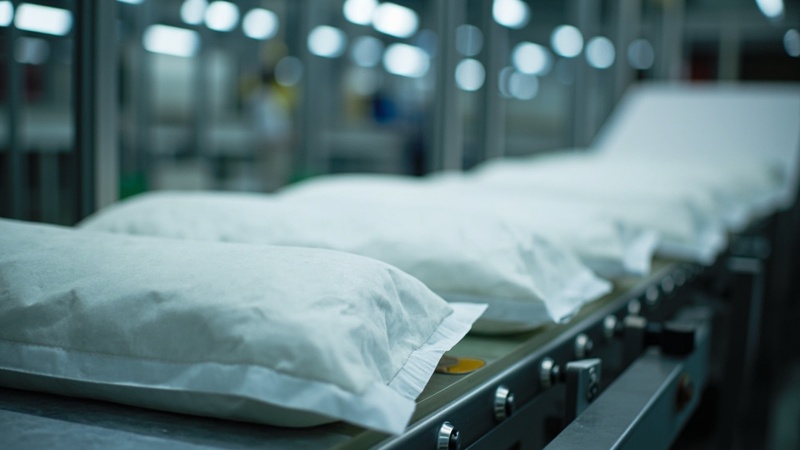
Key Takeaways
Quick answer: A flow wrapper (HFFS) wraps products in heat-sealable film in one continuous, synchronized motion: infeed, film feed, forming, long seal, cross seal, cut-off.
- Continuous synchronized process — product entry, film feeding, wrapping, sealing, cutting and discharge run as one motion chain
- PLC is the brain — a controller synchronizes infeed, film feed and sealing, manages temperature and monitors safety
- Synchronization is everything — encoder-timed coordination of five points prevents misaligned seals, film tears and wrong lengths
- Film type sets seal temperature — BOPP, CPP, laminates and foils each have their own typical sealing ranges
- Typical operating window — the article cites 30-600 packs/min, 50-600mm package length, 120-200°C sealing
Now that you know the forming formula, run your own product through it — see the exact bag your flow wrapper would form.
Calculate your product’s bag size →Introduction
Understanding how a flow wrapper works is essential for anyone involved in packaging operations—whether you’re selecting equipment, training operators, or troubleshooting issues.
In this complete technical guide, we’ll explain the complete operating principle of horizontal flow wrapping machines, breaking down each system and component so you can understand exactly what’s happening inside your machine.
For a comparison of flow wrappers with other packaging technologies, see our detailed flow wrapper vs HFFS guide.
From building flow wrappers for food, pharmaceutical and cosmetics production, we’ll give you practical insights you won’t find in any technical manual.
Key Takeaway: A flow wrapper is a precision machine that wraps products in film using a combination of forming, sealing, and cutting operations—all synchronized to handle thousands of products per hour.
How Do You Handle The Basic Operating Principle?
A flow wrapper (Horizontal Form Fill Seal – HFFS) is a packaging machine that automatically wraps products in heat-sealable film. The process is continuous and highly synchronized:
Product Entry → Film Feeding → Product Wrapping → Longitudinal Seal → Cross Sealing → Cut-off → Discharge
Key characteristics:
– Continuous motion (most modern machines)
– Horizontal product flow
– Film from roll above product
– Three seals per package (two cross seals + one longitudinal seal)
How Do You Handle System-by-System Breakdown?
The system-by-system walkthrough below follows the film path of a horizontal flow wrapper such as the JC250 Flow Wrapping Machine — the same sequence applies to the wider-format JC420 Flow Wrapping Machine.
1. Product Infeed System
Purpose: Deliver products to the wrapping area at controlled intervals and positions.
Components:
– Infeed conveyor: Typically 500-1000mm long, adjustable speed
– Sprocket wheels or timing screws: Space products evenly
– Guide rails: Keep products aligned
– Product detection sensors: Tell the machine when products are present
How it works:
1. Products enter on an infeed conveyor
2. Timing screws or flights space products according to package length
3. Products slide into the wrapping area at controlled intervals
4. Sensors detect product position for synchronization
Key specifications:
– Conveyor width: 200-600mm (matches film width)
– Speed range: 5-100 meters/minute
– Product spacing accuracy: ±2mm
2. Film Unwind and Feed System
Purpose: Unroll film from the roll and position it around the product.
Components:
– Film unwinder: Holds film roll (diameter up to 400mm)
– Squares or dancers: Maintain consistent film tension
– Film guide rollers: Position film correctly
– Forming collar: Shapes film around the product
– Film folding plates: Fold film edges before sealing
How it works:
1. Film roll is mounted on the unwind stand
2. Film passes through dancer/square system for tension control
3. Film is guided over the forming collar
4. Film edges are folded by forming plates
5. Film continues into the sealing station
Film specifications:
| Parameter | Typical Range |
|:—|:—|
| Film width | 200-600mm |
| Film thickness | 20-60 microns |
| Roll diameter | 300-400mm |
| Roll core | 76mm (3″) |
| Max weight | 30-50kg |
3. Forming and Wrapping Area
Purpose: Wrap the film around the product and prepare it for sealing.
Components:
– Forming collar: Metal form that shapes flat film into tube
– Folding plates: Fold film edges to meet at top of product
– Guide rails: Keep product centered during wrapping
– Accumulation belt: Compensates for intermittent motion (if applicable)
Related: How to Operate a Flow Wrapper:
How it works:
1. Flat film meets forming collar
2. Film wraps around the collar shape
3. Folding plates bring film edges together at top
4. Product passes through the formed film tube
5. Film is gathered around the product
Critical adjustment areas:
– Forming collar width (matches product width + clearance)
– Folding plate angle (adjusts for different film stiffness)
– Guide rail position (centers product in film)
4. Longitudinal Sealing System
Purpose: Create the longitudinal seal that closes the film around the product’s length.
Components:
– Seal roller (hot knife or heated belt): Applies heat and pressure
– Counter roller: Provides backing for sealing
– Temperature controller: Maintains precise seal temperature
– Pressure adjustment: Controls seal compression
How it works:
1. Film edges meet at the top of the product
2. Heated seal roller presses film against counter roller
3. Heat and pressure create permanent seal
4. Film continues through machine with longitudinal seal complete
Technical specifications:
| Parameter | Typical Range |
|:—|:—|
| Seal width | 8-15mm |
| Temperature | 120-200°C (depending on film) |
| Pressure | Adjustable |
| Seal strength | 70-90% of film strength |
5. Cross Sealing System
Purpose: Create the end seals that close each individual package.
Components:
– Two sealing bars (upper and lower): Apply heat and pressure
– Anvil plate: Provides backing surface
– Cam or servo system: Controls seal timing
– Cut-off knife: Integrated with seal bar
How it works (continuous motion):
1. Film tube moves continuously through machine
2. Rotating seal bars open and close
3. When product reaches seal position, bars close
4. Heat and pressure create cross seal
5. Knife cuts between seals, separating packages
How it works (intermittent motion):
1. Film and product stop at seal station
2. Seal bars close together
3. Heat and pressure create cross seal
4. Knife cuts through film
5. Film advances one package length
6. Process repeats
Seal types:
| Seal Type | Application | Characteristics |
|:—|:—|:—|
| Constant heat | Standard films | Simple, reliable |
| Impulse | Heat-sensitive films | No constant heating |
| Ultrasonic | Specialty films | No heat required |
6. Discharge System
Purpose: Remove finished packages from the machine and deliver to downstream equipment.
Components:
– Discharge conveyor: 300-1000mm long
– Product guide rails: Keep packages aligned
– Finished product sensor: Detects output
– Connection brackets: Link to downstream equipment
How it works:
1. Sealed and cut packages exit seal station
2. Packages land on discharge conveyor
3. Conveyor moves packages away from machine
4. Packages are guided to next process (cartoner, case packer, etc.)
How Do You Handle Machine Control System?
PLC Control (Siemens S7-1200 Example)
The Programmable Logic Controller (PLC) is the “brain” of the flow wrapper:
Core functions:
1. Motion control: Synchronize infeed, film feed, and sealing
2. Temperature control: Manage seal temperatures precisely
3. Safety monitoring: Emergency stops, guards, interlocks
4. Fault detection: Identify and respond to problems
5. Operator interface: HMI for settings and diagnostics
Key specifications:
– Processing speed: <10ms cycle time
– I/O points: 50-200+ (depending on complexity)
– Communication: Ethernet, Profibus, or PROFINET
– Backup: Cloud + local SD card
HMI Touchscreen Interface
The Human-Machine Interface (HMI) allows operators to:
– Set package parameters (length, speed, temperatures)
– Monitor production statistics
– View and clear faults
– Access diagnostic information
– Store product recipes
Screen examples:
– Main operating screen: Speed, count, status
– Parameter screen: Package dimensions, seal temperatures
– Diagnostics screen: Fault history, sensor status
– Production report: Output, efficiency, waste
Why Is Synchronization the Key to Performance?
Why synchronization matters:
A flow wrapper must precisely synchronize:
1. Product arrival at wrapping area
2. Film positioning
3. Longitudinal seal placement
4. Cross seal timing
5. Cut-off position
Synchronization errors cause:
– Misaligned seals
– Film tears
– Incorrect package lengths
– Product damage
How it’s achieved:
1. Encoder on main drive shaft
2. Encoder on product infeed
3. PLC calculates timing for each function
4. Servo drives (premium machines) provide precise control
Accuracy requirements:
– Package length tolerance: ±1mm
– Seal position tolerance: ±0.5mm
– Film tracking tolerance: ±1mm
How Do You Handle Film Types and Sealing?
Common Film Materials
| Film Type | Properties | Applications |
|---|---|---|
| BOPP | Clear, heat sealable, economical | Snack foods, bakery |
| CPP | Flexible, good seal strength | General packaging |
| Laminated OPP | High barrier, print quality | Premium products |
| PE | Flexible, sealable | Frozen foods |
| Foil laminate | Complete barrier | Pharma, medical |
Seal Temperature Guide
| Film Type | Typical Seal Temp | Notes |
|---|---|---|
| BOPP | 120-140°C | Fast cycling |
| CPP | 130-150°C | Moderate |
| Laminated | 150-180°C | Follow manufacturer specs |
| PE | 110-130°C | Lower temperature |
How Do You Handle Common Operating Parameters?
| Parameter | Typical Range |
|---|---|
| Speed | 30-600 packs/min |
| Package length | 50-600mm |
| Film width | 200-600mm |
| Product width | 10-250mm |
| Product height | 5-150mm |
| Seal temperature | 120-200°C |
| Power consumption | 3-15 kW |
| Air pressure | 6-8 bar (if pneumatic) |
Run the Forming Formula on Your Own Product
The article shows the math behind bag forming. The free calculator applies the same formula to your numbers — product dimensions or fill weight in, film width and bag length out.
- ✓ Same formula as the article, automated
- ✓ Works for pillow and gusseted bags
- ✓ Bulk density reference table included
- ✓ Instant results, no email
Conclusion
Understanding how a flow wrapper works is fundamental to operating, maintaining, and troubleshooting these machines effectively. The key components—product infeed, film system, forming area, and sealing stations—all work together in precise synchronization to produce thousands of perfectly wrapped packages per hour.
Key Takeaways:
1. Flow wrappers use horizontal product flow with film from above
2. Three seals are created: one longitudinal, two cross seals
3. Precise synchronization is critical for quality output
4. Modern machines use PLC control for reliability and flexibility
5. Film type and temperature settings are crucial for seal quality
Need more technical information?
Our technical team provides complete operator training and ongoing support for all Path Pack machines. We also offer detailed technical documentation for maintenance and troubleshooting.
- 📞 Contact us for technical support
- 📧 Request technical documentation
- 🔍 Learn about our training programs
About Path Pack
To keep your machine running smoothly, follow our detailed maintenance checklist.
Path Pack builds horizontal packaging machines in Hangzhou, China. Every machine is tested with the customer’s product and film before it ships. If you are evaluating a flow wrapper or troubleshooting a line already in production, contact our engineering team — we reply within one working day.
Frequently Asked Questions
What does a flow wrapper do?
A flow wrapper automatically wraps products in heat-sealable film: it feeds the product, forms film around it, makes the longitudinal seal, cross-seals and cuts each package, and discharges finished packs — all in one continuous motion.
What are the main systems of a flow wrapper?
The main systems are the product infeed conveyor, the film feeding and forming assembly, the sealing stations (long seal and cross seal), the cutting unit, and the discharge — coordinated by a PLC control system.
Why is synchronization so important on a flow wrapper?
Five events — product arrival, film positioning, long-seal placement, cross-seal timing and cut position — must align within milliseconds. Synchronization errors cause misaligned seals, film tears, incorrect package lengths and product damage.
What film types can a flow wrapper seal?
Common films include BOPP, CPP, laminated OPP, PE and foil laminates. Each has a typical sealing temperature range — for example BOPP around 120-140°C — set per the film supplier’s specification.
What are typical operating ranges for flow wrappers?
The article cites typical ranges of 30-600 packs per minute, package lengths of 50-600mm, film widths of 200-600mm and sealing temperatures of 120-200°C, depending on machine size and product.
Want this walkthrough mapped onto a specific machine? → Send Path Pack your product details for a configuration that matches your output target.


 English
  Spanish
  French
  German
  Korean
  Russian
  Italian
  Arabic