
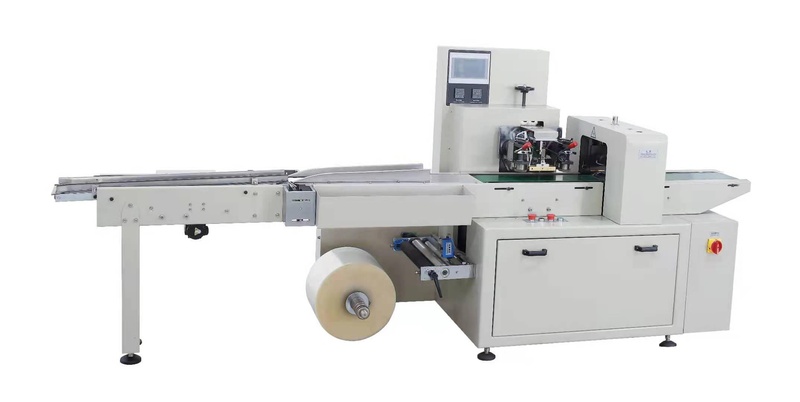
Before you sign for a flow wrapper, get specific answers on four things: the exact product size range it must run (widest, longest, tallest — not the average), the realistic production rate for your product and film rather than the nameplate maximum, the films it must seal with sealing samples you have seen, and who supports the machine after commissioning — spares, training and fault response. Most buyer’s remorse in flow wrapping traces back to one of these four being assumed instead of asked.
Key Takeaways
Quick answer: Before signing for a flow wrapper, get specific answers on four things: exact product size range, realistic speed for your product, film requirements, and life after delivery.
- A question list beats a spec sheet — twelve questions frame the buyer’s side of the table
- Product questions come first — widest, longest, tallest — not the average
- Film and format next — printed films and formats constrain machine choice
- Supplier and after-sales last — spares, response times and training decide year-two costs
- Turn answers into numbers — the article converts replies into comparable figures
Why a question list beats a spec sheet
Every flow wrapper datasheet shows the same optimistic numbers: a wide bag-size range, a headline speed, a sealing-temperature band. None of it tells you what happens when your product, your film and your operators meet the machine. A question list flips the conversation: instead of comparing brochures, you are testing whether the supplier actually knows where their machine’s limits are — and whether they will tell you honestly.
Suppliers who know their machines answer differently. They say “our JC250 runs 35–150 packs/min, and where you land in that range depends on product weight and film behavior — a sticky bakery item will not hit the top of the range.” That kind of answer is a signal. Vague yeses are the opposite signal.
The twelve questions below are grouped the way a purchase actually unfolds: what you’re packing, what you’re packing it in, the machine itself, and what happens after it ships.
Group 1 — Your product (questions 1–3)
1. What exactly will the machine run tomorrow — and in two years?
Bring the full product list, not the flagship SKU. The machine is sized by the worst case, not the average: the widest product sets the film width, the tallest sets the forming-box size, the longest sets the bag cut length. If a second product line is plausible within the machine’s life, say so now — format range bought later is bought twice.
2. What production rate do you actually need — nameplate or realistic?
Headline speed is measured on an ideal product with an ideal film by a test engineer. Realistic throughput is what your line sustains across a shift with product changes, film splices and operator breaks. Ask the supplier where your product sits in their speed range and why. If they quote the top of the range for every product, they are selling, not sizing.
3. What is your product’s worst-case dimension set?
Width, height and length — of the largest product you will run. On a horizontal flow wrapper, film width follows width + 2×height + fin allowance; every millimeter of product height is two millimeters of paid film, every shift, forever. Products at the edge of a machine’s range also run at the edge of its stability. Size for the worst case, not the portfolio average.
Group 2 — Film and format (questions 4–6)
4. Roll film or premade bags?
This one decision routes you to different machine families. Roll-fed flow wrappers form the bag around the product — lowest cost per bag, one reel change per shift, but the machine owns bag-making quality. Premade-pouch lines buy the bag and fill it — higher bag cost, but the bag is print-finished before it ever reaches your floor. If your product is a solid that nests on a conveyor, roll film is the default answer. If you are filling liquids or powders into stand-up pouches, you are not buying a flow wrapper at all, and a supplier who doesn’t tell you that is wasting your evaluation round.
5. Which films must it seal — and can you show me seals you made?
OPP, PE, CPP and their laminates each seal in a temperature-pressure-dwell window. Ask for sealing samples on your film or its equivalent, made on the model you are buying, not the model above it. A supplier who runs a film trial for you before the contract is a supplier who will run one for you after it.
6. How often will you change formats — and how long is one changeover?
If you run one SKU all year, changeover time is a footnote. If you run six, it is a weekly production cost. Ask what changes in a format change (film reel, forming box, guides, cut length recipe), what needs tools, what is servo-recalled from the HMI, and how long a trained operator takes. Then ask the same question about the machine you’re actually being quoted — not the demo unit.
Group 3 — The machine and the supplier (questions 7–9)
7. Servo or mechanical — and what are you actually paying for?
Servo drives buy registration accuracy on printed film, gentle product handling, faster format recall and fault diagnostics. Mechanical cam machines buy simplicity and a lower entry price, at the cost of adjustment time and fewer diagnostics. Neither is “better” — the honest question is which one matches your product value and your maintenance bench. A supplier pushing servo for a single-SKU biscuit line, or mechanical for a printed-film pharma line, is selling specs, not solutions.
8. When it faults, what happens?
Every machine stops; the difference is what the stop costs. Ask how faults surface (plain-text HMI alarm vs a blinking light), whether the PLC logs history you can send to support, and which spares are genuinely consumable — sealing jaws, heater bands, belts, knives — with their expected life on your product. “We courier parts worldwide” is not an answer; “this part, this lead time, this price band” is.
9. Who installs, commissions and trains?
Commissioning is where a good machine becomes a good line — or doesn’t. Ask who physically installs (you or their engineer), how many days commissioning typically takes for a machine like yours, what “accepted” means (a signed-off test on your product at agreed speed and seal quality), and how many operators get trained, on what, for how long. Trial runs on your product during commissioning should be in the contract, not a favor.
Group 4 — Life after delivery (questions 10–12)
10. What wear parts will you replace in year one?
Budget the machine, not the invoice. Sealing jaws wear against film and product abrasion, heater bands fail on duty cycles, knives dull against film laminates. Ask for the consumables list with expected service intervals, and check these are standard enough to stock. A machine whose wear parts are a mystery is a machine whose downtime is a surprise.
11. What does sealing quality mean, numerically?
“Good seals” is not a specification. Ask what the supplier’s bag-form qualified rate means, how it is measured, over what sample, and what happens in the warranty window if your line drifts below it. A number with a measurement method behind it is worth ten adjectives — and a supplier who quotes one without being asked is telling you they measure it anyway.
12. What happens after the warranty?
Ask about remote diagnostics, firmware and recipe support, engineer availability for line-side visits, and the spares pipeline for a machine bought today, five years from now. The cheapest machine to buy and the cheapest machine to own are rarely the same machine, and the difference shows up entirely after year one.
The twelve questions at a glance
| # | Question | Why it matters | A good answer sounds like |
|---|---|---|---|
| 1 | What will it run, today and in two years? | Machine sized by worst case, not average | “Bring your widest, tallest, longest product.” |
| 2 | Nameplate or realistic speed? | Throughput is product- and film-dependent | “Your product lands here in the range, because…” |
| 3 | Worst-case dimensions? | Edge-of-range products run edge-of-stability | “Size for this SKU, not the portfolio average.” |
| 4 | Roll film or premade bags? | Different machine families entirely | “For solids on a conveyor, roll film — here’s why.” |
| 5 | Which films, with samples? | Sealing windows differ per laminate | “Send us your film; we’ll run seals on this model.” |
| 6 | Changeover time and content? | Multi-SKU lines pay this weekly | “These parts, this time, tool-free for X and Y.” |
| 7 | Servo or mechanical? | Match drive type to product value, not specs | “For your printed film, servo, because registration.” |
| 8 | What happens on a fault? | Stops are inevitable; their cost isn’t | “Plain-text alarms, logged history, these spares.” |
| 9 | Install, commissioning, training? | Acceptance is a signed test, not a handshake | “N days, your product, agreed speed, signed off.” |
| 10 | Year-one wear parts? | Downtime hides in consumables | “This list, these intervals, stockable.” |
| 11 | Sealing quality, numerically? | Adjectives are not specifications | “≥97% qualified rate, measured thus.” |
| 12 | After the warranty? | Ownership cost shows up after year one | “Remote diagnostics, spares pipeline, this SLA.” |
Turn the questions into numbers
Half of these questions — product dimensions, film width, bag length, realistic sizing — you can answer yourself before ever contacting a supplier. Our bag size calculator turns product dimensions or fill weight into the film width and bag length a machine must hold, with the fit margin shop floors actually need, and shows which machines in the range take that bag as standard. Walk into your next supplier call already knowing what the machine has to hold.
When you are ready to see machines against those numbers, the flow wrapping machine range lists current models with their honest envelopes — or start with the JC250, the model most first-time buyers evaluate first.
FAQ
How much does a flow wrapper cost?
Entry benchtop machines and high-speed servo lines differ by an order of magnitude, and the number that matters — total cost of ownership — depends on film spend, wear parts, downtime and labor, not the invoice. We deliberately keep prices off web pages: a machine priced without seeing your product and film is a number, not a quote. Send us your product list and target output and you will get a real quotation.
What speed should I expect from a first flow wrapper?
For a typical single-lane horizontal flow wrapper running mid-weight products on standard laminates, the honest envelope is roughly 35–150 packs/min, with the sweet spot for most first-time buyers in the lower half of that band. Where you land depends on product weight, feeding stability and film behavior — which is exactly question 2 above.
Should a first-time buyer choose servo or mechanical?
If you run printed film where the cut must land on the eye mark, or several SKUs with frequent changeovers, servo pays for itself in registration accuracy and recall speed. For one plain-film SKU at moderate speed, a well-built mechanical machine is often the more sensible purchase.
Can one flow wrapper run all my products?
It can run everything within its format envelope — the forming set, film width range and cut length range. The useful exercise is the calculator one: convert each SKU’s worst-case dimensions to required film width and bag length, and see whether they all sit inside one machine’s envelope with room to spare. Where they don’t, the honest answer is two formats or a wider machine, and it is cheaper to know before the purchase order.
Ready to put these questions to work? → Send Path Pack your twelve answers — we reply with a machine recommendation and quotation.



 English
 Spanish
 French
 German
 Korean
 Russian
 Italian
 Arabic