
Print & Paper Packing Solutions
Magazines, greeting cards, diaries and printed products — flat goods that ship sealed with the print on show and the label on the film.
Why Flow Wrapping for Print & Paper
Print packing is a cleanliness-and-mailing story — the wrap protects the finish and carries the address.
Sealed Until the Shelf
Printed finishes mark and curl — a sealed wrap keeps covers clean and corners crisp to point of sale.
The Label Lives on the Film
Subscription copies wrap with the address printed on the film — one material, one pass, postal-ready.
Card Plus Envelope, One Unit
Greeting cards sell sealed with their envelope — two pieces become one unit at the till.
Flat Stacks Well
Flat products convey and stack in file — the geometry horizontal conveying handles natively.
Postal-Scale Economics
Light film on light products — the wrap adds grams, not weight, at mailing volumes.
Industry References
Subscription magazines arrive wrapped with the address label printed on the film — print-registered wrapping at postal scale.
Greeting cards sell with their envelope sealed in one film unit — card and envelope as a single shelf unit.
References describe publicly available retail pack formats as illustrations — they are not Path Pack customer cases.
Machines for Print & Paper
One engineering standard across three machine families — flow wrappers, four-side-seal sachet machines and horizontal premade-pouch lines. Every machine below is configured around the product it runs — each card links to the full machine page for detailed specs.
Flow Wrapping (HFFS) — magazines, cards and flat products
Flat-product configurations — infeed and film width sized to the format.
Four-Side-Seal Sachet Machines — flat sachets and portion packs
Flat sachets sealed on all four sides — portion-controlled, shelf-ready packs for flat products and counted single serves.
Horizontal Pouch Packing Machines — stand-up, zipper and spout pouches
Pouch formats for printed sets and samples — configuration confirmed per format.
Complete the Line — cartoning, blister and sleeving
Cartoning, blister packing and bag sleeving machines that pair with the packers above — one line, one engineering standard.
JCJ130 Compact Bag Sleeving Machine
Sealing Modes: (1) single-layer OPP film, heat-sealed; (2) OPP bags with double-sided adhesive-tape seal; (3) laminated premade bags
Bag Supply: OPP roll film and premade bags
Best-Fit Products: Stationery, red envelopes, kraft envelopes, awkward flat goods
Build Tier: Compact build — the JCS130 is the standard production build
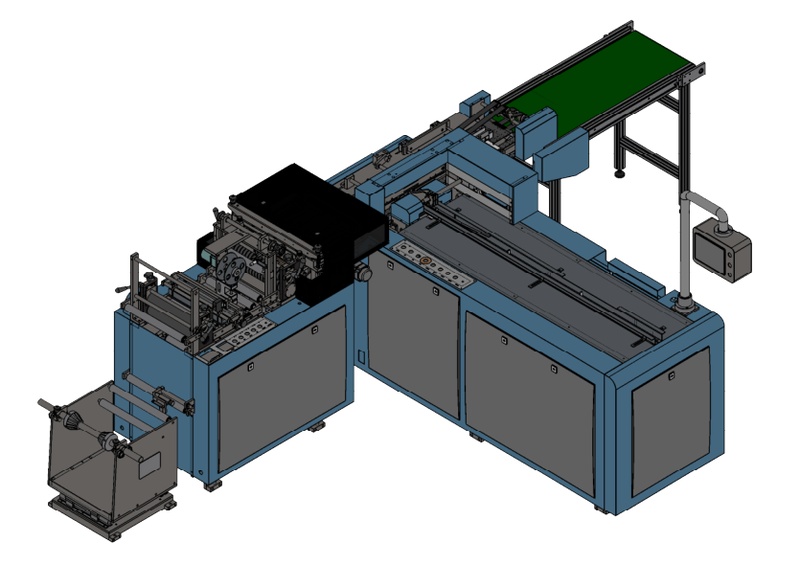
JCS130 Standard Bag Sleeving Machine
Bagging Speed: 30-50 bags/min (product dependent)
Pack Size (L x W x H): 80-300 mm x 80-240 mm, height up to 40 mm
Bag Supply: OPP roll film, max roll dia. 450 mm
Sealing Method: Self-adhesive closure, no heat applied
Power Supply: 220 V / 50 Hz
Compressed Air: 0.6-0.8 MPa
Total Power: 5 kW
Machine Weight: 1,600 kg
Footprint (L x W x H): 2,500 x 4,600 x 1,600 mm
Control System: Omron NX1P2 PLC, NB7W touch HMI
Servo System: Inovance servo drive, Omron motion module
Pneumatics: SMC valves, AirTac cylinders
Best-Fit Products: Stationery, red envelopes, kraft envelopes, flat print goods
Build Tier: Standard production build — the JCJ130 is the compact build
How to Choose a Print Packing Machine
Seven decisions frame the specification. Work them in order and the machine ends up matched to your product — not the other way around.
1. Product Type
Magazine, card, diary or notepad. Thickness and format drive the infeed.
2. Throughput
Postal volumes run high but gentle — match the class to the run length.
3. Film Material
Clear or printed film; address-window and label requirements follow the mailing route.
4. Seal Technology
Seals on light film without marking the cover — heat and dwell need tuning to the stock.
5. Package Format
Singles with inserts, or counted sets. Inserts change the grouping.
6. Inserts and Thickness
Covermounts and inserted cards vary the pack thickness — the infeed must tolerate the fattest pack in the run.
7. Configuration and Delivery
Address printing and insert verification extends delivery. Spec the mailing data early.
Frequently Asked Questions
Can magazines be flow wrapped?
Yes — flat printed products convey into film and seal postal-ready, with the address on the film where the route requires.
What about greeting cards?
Card-and-envelope units seal as one pack — the pair becomes a single shelf unit.
Do inserts work?
Inserted items run infeed-defined — the wrap seals around the fattest configuration in the run.
What speeds are available for print packing?
Configurations for this format span our full flow-wrapping range — 5 to 300 packs/min. The right class depends on your product, film and format; match speed to what your line actually sustains, not the headline number.
Why Path Pack
We start with the product, not the machine. Every project runs through the same nine-step engineering process — product, format, film, speed, feeding, sealing, structure, integration, testing — before a configuration is quoted.
Your products run on real machines with your film at your target speed before anything ships. Mailing-scale formats are exactly what the configuration review is for.
Evaluate your requirements with our online tools: the machine finder and bag calculator narrow the configuration before you ever talk to us.