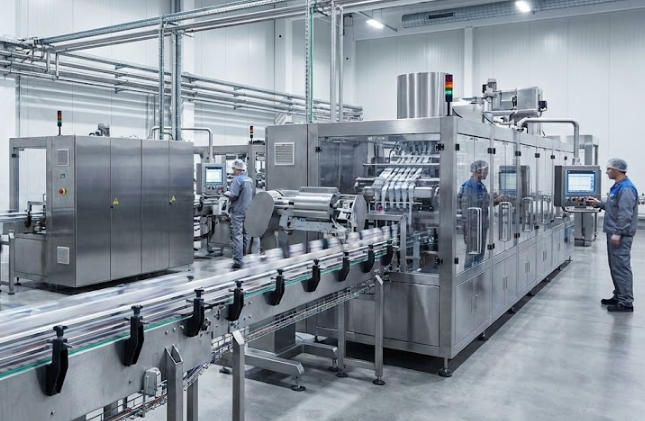
Flow Wrappers — Complete B2B Guide, Specs & Buyer Resources
Engineering resource hub: 25+ in-depth articles on selection, operation, maintenance & troubleshooting — written by Path Pack engineers for packaging engineers, plant managers, and procurement teams.
1,500+ installations • 40+ countries • Food / Pharma / Medical / Cosmetics
Quick Answers for Engineering Teams
The essentials, before you dive into specific guides.
Definition & Speed Range
A flow wrapper (HFFS) wraps solid products horizontally in a continuous film tube, sealing both ends. Speeds range 60–500+ ppm depending on configuration.
Selection Sequence
7 decisions in order: product type → throughput → film material → seal technology → package format → regulatory compliance → budget & lead time.
Rotary vs Linear
Rotary sealing suits 300+ ppm single-SKU lines. Linear sealing suits 60–150 ppm with frequent format changeover.
Seal Technology by Industry
Hot knife dominates food (up to 300 ppm). Ultrasonic dominates pharma & medical (hermetic, no product heating). Cold seal serves chocolate.
Path Pack Track Record
1,500+ custom-configured flow wrappers shipped to food, pharma, medical, cosmetics and industrial lines in 40+ countries.
Next Step
Use the sections below to drill into selection, operation, maintenance, troubleshooting — or skip to our engineering consultation for a tailored spec.
What Is a Flow Wrapper?
A flow wrapper — also called a horizontal form fill seal (HFFS) machine — forms a continuous roll of film into a tube around a product, seals the longitudinal seam underneath, then seals and cuts both ends.
Unlike vertical form fill seal (VFFS) machines that drop product into a vertical tube for granular or liquid goods, flow wrappers handle solid, regular-shaped products fed horizontally into the film web.
Common configurations:
• Economy cam-driven: 60–150 ppm
• Servo-driven standard: 150–300 ppm
• Servo-driven high-speed: 300–500 ppm
• Ultrasonic sealing: 100–300 ppm (pharma/medical)
The 4-Stage Process
1. Film feeding
Roll stock unwinds through forming collar
Roll stock unwinds through forming collar
2. Product loading
Products fed horizontally into film tube
Products fed horizontally into film tube
3. Longitudinal sealing
Bottom film edges heat-sealed along pack length
Bottom film edges heat-sealed along pack length
4. End sealing & cutting
Rotary or ultrasonic cutters seal both ends
Rotary or ultrasonic cutters seal both ends
How to Choose the Right Flow Wrapper
Specifying a flow wrapper is a 7-decision sequence. Skip any decision and you risk buying a machine that cannot hit throughput, fails regulatory audit, or cannot run your future SKU mix.
1. Product Type
Solid, fragile, sticky, or multipack. Determines infeed method and film format.
2. Throughput (60–500 ppm)
Drives choice between cam-driven economy and servo-driven high-speed.
3. Film Material
OPP, PET, PE, laminates, or cold-seal. Affects seal bar temperature range and cutting method.
4. Seal Technology
Rotary, hot knife, ultrasonic, or cold seal. Determines pack integrity and product compatibility.
5. Package Format
Single item, multipack, or tray-loaded. Affects product loader design.
6. Regulatory Compliance
FDA, EU GMP, ISO 11607, ISO 22716. Drives material selection, validation scope, documentation.
7. Budget & Lead Time
Custom configurations take 8–16 weeks; standard builds 4–8 weeks.
Full Buyer Guides →
35-checkpoint buyer guide, selection checklist, and small-business cost guide.
Decision Framework by Product Category
Bakery & Confectionery
Servo-driven + cold-seal capability + low-tension infeed. Target 200–300 ppm single-lane.
Pharma Blisters
Ultrasonic sealing + SS316L contact parts + Ra<0.8µm + full IQ/OQ/PQ. 12–16 week lead.
Cosmetics Multipacks
Multi-format servo wrapper + quick-change tooling. Premium film handling over peak speed.
Hardware & Industrial
Heavy-duty servo infeed that handles metal parts without film puncture.
Seal Technology & Configuration Comparisons
Two technology choices define a flow wrapper's capability envelope: mechanical configuration (rotary vs linear) and seal/cut method (hot knife vs rotary cut-off vs ultrasonic).
Rotary vs Linear
Rotary: 200–500 ppm, lower format flexibility, higher cost. Best for high-volume single-SKU lines.
Linear: 60–150 ppm, higher format flexibility, lower cost. Best for multi-SKU frequent changeover.
Hot Knife vs Rotary Cut-Off
Hot Knife: Heated blade cuts+seals simultaneously. Up to 300 ppm. Best for thick laminates / PE.
Rotary Cut-Off: Mechanical blade + separate sealing jaws. Up to 500 ppm. Best for thin films (OPP, cellophane).
Operation & Setup — 11 Core Procedures
Once a flow wrapper is installed, operators must master these eleven procedures. Each is documented in depth in our operations library.
Easy • 30 min
Medium • 15 min
Medium • 20 min
Advanced • 45 min
Advanced • 2 hrs
Medium • 15 min
Advanced • 1 hr
Critical • Ongoing
Optimization
Advanced
Maintenance & Troubleshooting
Sustained uptime depends on four maintenance pillars. When things go wrong, the cause almost always falls into six failure categories.
Maintenance
10-point pre-shift
12–14 points (servo)
60% of intermittent faults
Weekly inspection
Troubleshooting
Longitudinal seal creases
Below rated speed
Eye-mark misread
HMI error codes
Jerky motion, alarms
False detections
Industry Applications
Path Pack flow wrappers serve six primary industries. Each has distinct requirements that drive machine configuration.
Food & Beverage
High speed (200–500 ppm), SS304 frame, IP65, OPP/PET/metalized/cold-seal films.
Pharmaceutical
GMP, IQ/OQ/PQ validation, 21 CFR Part 11, SS316L, ultrasonic sealing preferred.
Medical Devices
ISO 11607 sterile barrier, Tyvek/foil, ASTM F88/F1929/F2096 integrity testing.
Cosmetics & Personal Care
Premium film handling, multi-format flexibility, quick-change tooling.
Path Pack Flow Wrapper Models
Models span 60–500 ppm throughput, from cam-driven economy builds to fully servo-driven ultrasonic systems.
Servo-driven standard — 150–300 ppm — Hot knife / rotary — Food, hardware
Servo-driven high-speed — 300–500 ppm — Rotary cut-off — Bakery, confectionery
Ultrasonic sealing — 100–300 ppm — Ultrasonic — Pharma, medical
Economy cam-driven — 60–150 ppm — Hot knife — Small business, multi-format
Custom integrated line — Per spec — Per spec — Turn-key projects
Featured product:
Horizontal flow wrapping solution for primary and secondary multipack applications.
Talk to a Flow Wrapper Engineer
Not sure which model fits your product mix? Path Pack engineers review your specifications and recommend a configuration — usually within 24 hours.
What to send us:
• Product drawings or photos (L × W × H)
• Target throughput (packages per minute)
• Film material preference
• Regulatory requirements
• Plant layout constraints
What you receive:
✓ Free machine specification review
✓ Film material recommendation
✓ Speed calculation for your product mix
✓ Formal quotation with lead time