
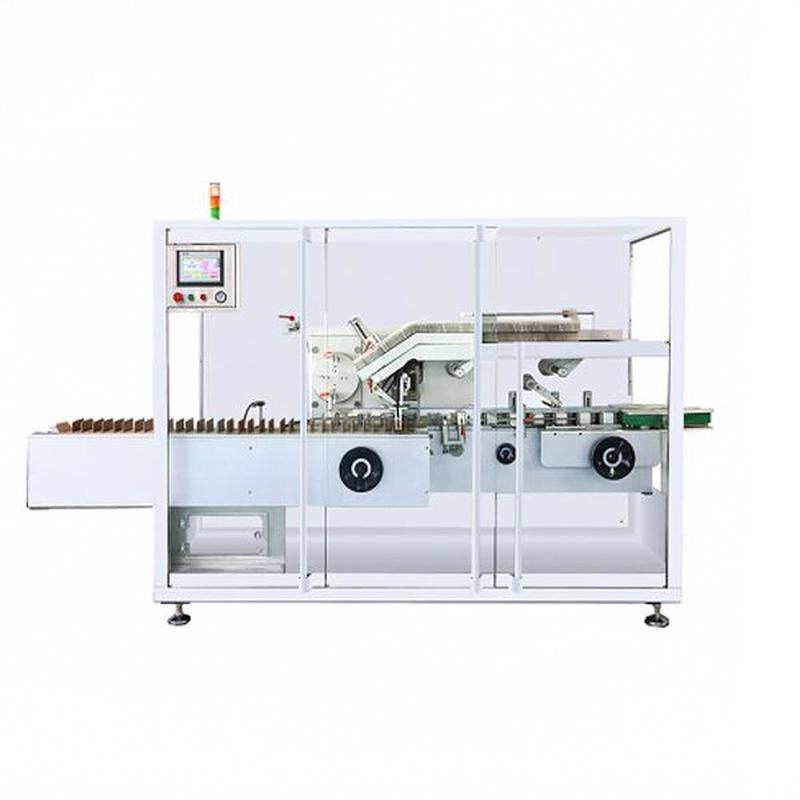
A horizontal cartoning machine erects a folded carton blank, pushes your product into it from the side, and closes it — tuck-in flaps, glue, or both — at 20 to 200 cartons per minute. This guide covers what to specify before you request a quotation: carton dimensions and board weight, carton style, leaflet handling, feeder stations, rejection logic and what has to run in front of the cartoner to keep it fed.
Key Takeaways
- Carton size window is the first filter: the JC130 runs 70–210 × 60–150 × 15–60 mm cartons; the JCH200 is engineered to order around your carton.
- Board weight the machine can handle: 250–400 g/m².
- Carton styles: tuck-in, auto-lock bottom, hang-tab — chosen by product weight and retail display, machined by the same headwork.
- Speed tiers: 20–60 cartons/min standard build, 200 cartons/min high-speed build — both carton- and product-dependent.
- Specify the upstream: what feeds the cartoner (flow-wrapped multipacks, sachets, pouches, blisters) determines the feeder stations and grouping.
What a Horizontal Cartoner Actually Does
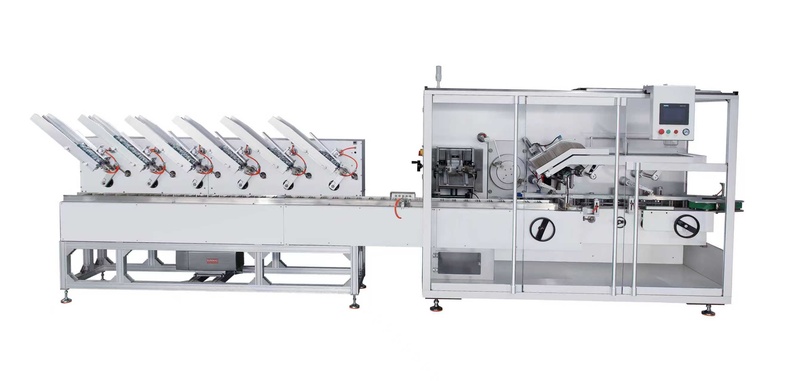
The machine cycle has four beats. A stack of folded carton blanks sits in a magazine; vacuum suckers peel one blank off the stack and erect it between chain flights. Product arrives on an infeed conveyor — single items or pre-grouped bundles — and a pusher inserts it into the open carton from the side. The flaps close: tuck-in flaps fold and lock, a glue unit can seal instead, and the finished carton discharges to case packing or a checkweigher.
Everything you specify — carton window, board weight, style, leaflet, feeders — maps onto one of those four beats. When a cartoner struggles in production, the cause is nearly always a mismatch between the carton and one beat: blanks too light to erect cleanly, product too tall for the pusher lane, flaps that will not hold tuck under retail handling.
Horizontal (Side-Load) vs Vertical (Top-Load) Cartoners
| Horizontal / side-load | Vertical / top-load | |
|---|---|---|
| Loading action | Product pushed into the erected carton from the side | Product dropped into the carton from above |
| Best for | Stable, rigid or wrapped items — flow-wrapped multipacks, sachet stacks, pouches, trayed product | Loose, fragile or nested items that settle by gravity |
| Speed class | Standard to high speed | Typically lower speed |
| Footprint | Long and low | More compact footprint for the same output |
The JC range is horizontal side-load — the configuration most printed-carton retail packaging runs on, because side insertion handles the wrapped, stackable products that dominate food, pharma and consumer goods.
The JC Cartoning Range at a Glance
| Spec | JC130 standard build | JCH200 high-speed build |
|---|---|---|
| Production rate | 20–60 cartons/min (carton- and product-dependent) | 200 cartons/min |
| Carton size (L×W×H) | 70–210 × 60–150 × 15–60 mm | Engineered to order around your carton |
| Board weight | 250–400 g/m² | Confirmed with carton at order |
| Carton styles | Tuck-in, auto-lock bottom, hang-tab | Tuck-in, auto-lock bottom, hang-tab |
| Product feeding | 4-station auto feeder standard; 5- and 10-station to order | Built to the product family |
| Options | Leaflet folding device, glue-sealing unit, single-side label sealing | Per project |
| Rejection | Auto-reject for missing product or leaflet; overload auto-stop | Per project |
| Utilities | ≥0.6 MPa, 120–160 L/min air; 1.5 kW | Per project |
| Footprint / weight | 4,620 × 1,210 × 1,800 mm; 2,800 kg | Per project |
The two tiers answer different questions. The JC130 is the standard production machine: a fixed carton window, a published spec sheet, options you can tick. The JCH200 starts from the other end — you bring the carton and the product family (coffee and snack pouches, sachet multipacks, bottled pharma, kit sets) and the machine is engineered to hold 200 cartons/min on it.
Six Things to Specify Before You Request a Quote
1. The carton drawing, closed and erected
All three dimensions matter, and the working window is tighter than the absolute one. Note the JC130’s quoted medical build: cartons verified at 80–110 × 80–110 × 30–90 mm, checked per carton — a narrower window inside the general range, because validated applications warrant tighter confirmed limits. Send the die-line; a supplier quoting without it is quoting a catalog page, not your project.
2. Board weight
250–400 g/m² covers standard folding carton board. Below about 250 g/m², blanks get floppy in the erecting station — suckers tear tabs, erected cartons lean in the chain. Above 400 g/m², creases stop folding crisply at speed. If your brand standard sits outside the window, say so early; the fix is a headwork change, not a parameter.
3. Carton style
Tuck-in is the retail default and runs fastest. Auto-lock bottom costs a little speed and buys a carton that carries heavier product without a glue station. Hang-tab cartons display on pegs and need the tab folded into the headwork. All three run on the same JC headwork — the choice is really about product weight and how the carton hangs in the store.
4. Leaflet handling
Pharma and kit-set cartons carry leaflets. The leaflet folding device takes folded literature, matches it to the product, and inserts it ahead of the product pusher — and the auto-reject pulls any carton that is missing product or leaflet. If your market requires leaflet-in-carton verification, specify it as a rejection criterion, not just an insertion option.
5. Product and bundle dimensions
The cartoner moves your product as presented: a flow-wrapped multipack, a sachet stack, a pouch, a blister board. Give the wrapped dimensions and weight, and how the bundle arrives — orientation, grouping, spacing. Feeder stations are chosen against this: the 4-station standard feeder covers counted items; 5- and 10-station feeders raise insertion density for higher speeds.
6. Target cartons per minute, honestly
Rate a cartoner the way you rate a pouch machine: shift output ÷ operating hours ÷ realistic uptime. Sixty cartons/min at 75% efficiency is roughly 21,000 cartons per 8-hour shift — far beyond what most single-retail-SKU lines ship. The 20–60/min tier is right for the majority of wrapped-food and consumer-goods lines; the 200/min tier earns its place on high-volume pharma and multipack lines.
Pharmaceutical and Medical Considerations
Cartoning for regulated product adds three conversations. First, the documented build: the JC130’s medical-build window above is the pattern — a narrower, verified carton range with per-carton checks, quoted as its own configuration rather than promised off the standard sheet. Second, machine safety and validation context: packaging machinery safety in North America is anchored by ANSI/PMMI B155.1, and suppliers working in the space should speak to it (see PMMI); where the carton is the sterile barrier’s secondary protection, ISO 11607 vocabulary applies to the barrier system itself (ISO). Third, rejection and traceability: missing-product and missing-leaflet rejection with overload stop is standard; batch-level event logging is specified per project. Bring your regulatory frame to the first call and let the supplier scope against it (confirm current standard editions with your compliance team before relying on them).
For context on the formats feeding regulated cartons, the medical device packaging pillar and the medical and healthcare solutions page collect the related guides.
Integration: What Runs In Front of the Cartoner
A cartoner without an upstream is a very expensive box folder. The typical feeds and how they shape the machine:
- Flow-wrapped multipacks — pillow packs from a flow wrapper arrive in ranks; the JC130’s feeder counts and pushes them as bundles. Start with the flow wrapper buying guide if the primary pack is not yet chosen.
- Sachet and four-side-seal multipacks — the cost logic between sachet and pillow formats is laid out in Four-Side-Seal vs Pillow Pack; cartoners take either, grouped.
- Pouches — coffee and snack pouches are a named JCH200 family; the pouch side is covered in our pouch packing machine buyer’s guide.
- Blister boards — sized to the carton’s inner footprint; see the blister packing machine buyer’s guide.
- Counting and arranging — when small items need grouping ahead of insertion, a feeding-and-arranging machine such as the PPMH280 queues them at up to 280 packs/min.
The handoff spec that matters most: product pitch and orientation at the infeed. Get the upstream machine’s discharge cadence in writing before the cartoner build is fixed, and the two machines will run as one line. The full staging picture — primary pack, secondary carton, feeding between them — is mapped in our end-of-line packaging machines guide.
Utilities and Installation
The JC130 runs on 1.5 kW with 220/380 V supply — cartoners are air machines more than power machines: plan ≥0.6 MPa at 120–160 L/min. The working footprint is 4,620 mm long, so budget infeed and discharge conveyance around it, and 2,800 kg of floor loading. Control hardware is Siemens PLC with touchscreen, frequency converter and servo drive; pneumatics are SMC valves and cylinders with vacuum and air preparation; sensors are Sick and Omron. That component tier is what makes the machine auditable in food and pharma plants — the bill of materials reads like the rest of the line.
Carton Changeovers and Format Parts
Cartoners are format machines: moving between carton sizes swaps the erecting suckers’ pickup points, the chain flight pitch, the pusher lane and the closing stations. Within the machine’s window, a size change is a parts-and-settings procedure measured in tens of minutes; outside the window, it is a different engineering conversation. What keeps changeovers predictable:
- Carton family discipline. Designing an SKU family around one erected length keeps the flight pitch and pusher set common across flavors — the cheapest changeover is the one that shares parts.
- Format parts bought with the build. The second carton size’s parts, ordered with the machine, get fitted and proven at commissioning instead of back-ordered mid-season.
- Board consistency. Two cartons with the same footprint but different board calipers erect differently. Keep board weight constant across the family and the erecting station stops being the variable.
Ask any supplier for the changeover procedure between your two most-likely carton sizes, in writing, at quotation stage. The answer quality tells you what commissioning will feel like.
Acceptance Testing: Verify Before the Machine Ships
An acceptance run with your cartons and your product is the only evidence that matters. The minimum protocol:
- Your production carton blanks, from the board supplier you will actually use, at the grammage you will actually buy — not the supplier’s demo blanks.
- Your product as wrapped, in the orientation and grouping the upstream will actually deliver.
- Target rate held for a timed run — long enough that erecting misses, insertion faults and flap failures all surface, with the reject count logged.
- Rejection proven, not promised: feed the machine deliberate no-product and no-leaflet conditions and watch each one auto-reject.
- Overload behavior demonstrated: a deliberate jam should stop the machine, not crush through it.
- Settings documented — flight setup, pusher stroke, glue temperature if glued — so your operators start from numbers, not folklore.
Put that protocol in the purchase documents. Suppliers who resist item 4 and 5 are telling you something.
Hang-Tabs, Auto-Lock and Display Cartons in Practice
The three carton styles the JC headwork runs answer three retail situations, and choosing among them is a merchandising decision that becomes a machine specification:
- Tuck-in is the default for a reason: fastest closing, clean re-opening for inspection, and no consumables. It carries typical wrapped-goods weights without drama.
- Auto-lock bottom trades a little speed for a carton that assembles its own rigid base — the answer for heavier contents, multipacks, or anything that gets picked up by its base a hundred times a day on the shelf.
- Hang-tab puts the carton on a peg. The tab fold is machined into the headwork, and the calculation to check is display density: peg hanging multiplies facings per meter of shelf, which is why hang-tab versions of a tuck-in carton appear in the same SKU family.
Two structural notes worth raising with your carton converter early. First, the glue-sealing unit option exists when tuck flaps alone will not satisfy tamper expectations or load — mixing glued and tucked SKUs on one machine is a settings change, not a rebuild. Second, board caliper consistency matters more than board weight peak: the erecting station loves consistency and tolerates mid-range. Specify caliper tolerance to your converter with the same seriousness you specify color.
FAQ
How many cartons per minute do I need?
Multiply shift output by 1.3–1.4 to cover uptime below 100%, then divide by operating minutes. Most wrapped-food and consumer lines land between 25 and 60 cartons/min — the standard JC130 tier. High-volume pharma and multipack lines justify the 200 cartons/min JCH200 tier.
What carton size range can one machine handle?
The JC130’s window is 70–210 mm long, 60–150 mm wide, 15–60 mm high, on 250–400 g/m² board. Change-parts set the machine to a size; format changes within the window are minutes, not hours. Outside the window, the machine is engineered to order instead.
Tuck-in or glue-sealed cartons?
Tuck-in runs fastest and re-opens cleanly for retail inspection; the JC130 takes a glue-sealing unit as an option where tamper evidence or heavier loads demand it, and a single-side label-sealing unit where a security label replaces glue.
Can the cartoner insert leaflets?
Yes — a leaflet folding device matches folded literature to the product ahead of insertion, and the rejection system pulls cartons missing product or leaflet automatically.
What happens when a carton is missing product?
Auto-reject: the machine detects the empty carton and ejects it from the flow without stopping, and an overload condition stops the machine rather than crushing a jam. Both behaviors are standard, not options.
How long does a carton size changeover take?
Tens of minutes within the machine’s window with format parts in hand: pickup points, flight pitch, pusher lane and closing stations reset to the new size. Carton families sharing an erected length change over fastest.
Can one cartoner run several SKUs?
Yes — that is the point of the size window. The JC130 spans 70–210 × 60–150 × 15–60 mm; SKUs inside one window change over by parts-and-settings, and board weight held constant across the family keeps erecting behavior stable.
What spare parts should I hold at commissioning?
Wear items for the erecting suckers and vacuum system, pusher belts, glue-unit wear parts if glued, and the format parts for your second carton size. Agree the list at quotation so it ships with the machine.
What should I tell my carton converter before the machine is built?
Send the machine supplier’s carton window and the die-line to the converter together: board weight inside 250–400 g/m², caliper tolerance held tight, crease geometry matched to the closing style, and blanks packed to suit the magazine. The converter and the machine supplier both working off the same drawing is what makes the first run uneventful.
Spec Checklist Before You Inquire
- Carton die-line with closed and erected dimensions
- Board weight and carton style (tuck-in / auto-lock / hang-tab)
- Product as wrapped: dimensions, weight, orientation, grouping
- Leaflet: yes/no, folded size, verification requirement
- Target cartons per minute and shift structure
- Upstream machine and its discharge cadence
- Regulatory frame: food, pharma, medical — and what must be verified
- Utilities: air capacity at 0.6 MPa, power, floor length
Run your format through the free selector at tool.path-pack.com to confirm cartoning is the right stage for your product, then send the checklist — a quotation against your carton drawing, not a catalog guess.

 English
 Spanish
 French
 German
 Korean
 Russian
 Italian
 Arabic