
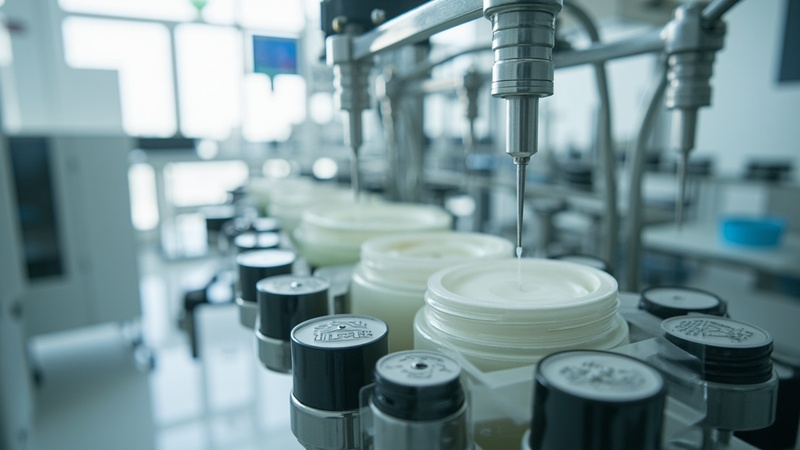
Cosmetics Packaging Machines — Beauty Selection & Compliance
Quick-change tooling, premium film handling, ISO 22716.
Selecting a cosmetic packaging machine requires comparing speed, format flexibility, film compatibility, and total cost of ownership across multiple machine configurations. This guide gives engineering and procurement teams a structured checklist with spec ranges, price bands, and decision criteria — distinct from our compliance and beauty standards guide, which covers ISO 22716, FDA, and EU regulatory scope.
Use this guide when you have a defined product portfolio and need to translate it into a machine specification ready for quotation.
Key Takeaways
Quick answer: Cosmetic packaging machine selection is driven by format flexibility, quick-change tooling and aesthetic seal quality — spec bands differ by product category.
- A 9-point checklist — the article walks the criteria cosmetic buyers should score
- Spec bands by category — speed and format expectations differ across cosmetics product types
- Quick-change tooling is key — multi-SKU cosmetics lines live on fast format changeover
- Aesthetic QC integration — vision and seal-quality checks belong in the specification
Part of: Cosmetics Packaging Machines — Complete Pillar
The 9-Point Cosmetic Machine Selection Checklist
| # | Criterion | What to specify | Why it matters |
|---|---|---|---|
| 1 | Product formats | List every SKU with dimensions and weight | Drives format range and quick-change tooling scope |
| 2 | Throughput per SKU | Target ppm for each SKU, not just peak | Determines servo vs cam-driven, multi-lane vs single |
| 3 | Film materials | Current film specs + aspirational sustainability films | Affects seal bar temp range and tension control |
| 4 | Seal technology | Hot knife, rotary cut-off, ultrasonic, or cold seal | Determines aesthetic quality and product compatibility |
| 5 | Changeover frequency | SKUs per shift, changeover time target | Quick-change tooling ROI calculation |
| 6 | Aesthetic QC scope | 100% vision inspection or sampling | Vision system integration and cost |
| 7 | Material standard | SS304 vs SS316 for skincare contact | Cleanability and corrosion resistance |
| 8 | Footprint constraints | Floor space, ceiling height, adjacent equipment | Compact configurations vs standard |
| 9 | Validation deliverables | FAT, SAT, ISO 22716 documentation scope | Project timeline and cost |
Blister and patch formats for cosmetics run on equipment such as our JCP100 Blister Packing Machine.
Cosmetic Packaging Machine Types — Spec Comparison
Horizontal Flow Wrappers (Primary Recommendation)
| Configuration | Speed range | Film compatibility | Seal options | Relative cost |
|---|---|---|---|---|
| Economy cam-driven | 60–150 ppm | OPP, thin laminates | Hot knife | $ |
| Servo-driven standard | 150–250 ppm | OPP, PET, metalized, paper-backed | Hot knife, rotary cut-off | $ |
| Servo-driven premium | 200–300 ppm | All films incl. holographic, matte | Hot knife, rotary, ultrasonic | $$ |
| Multi-lane sachet | 200–400 ppm total | Foil, PET-PE laminate | Ultrasonic, continuous heat | \(\) |
VFFS (For Sachets and Powder Cosmetics)
| Configuration | Speed range | Best for | Relative cost |
|---|---|---|---|
| Single-lane VFFS | 60–120 ppm | Powder masks, dust cosmetics | $ |
| Multi-lane VFFS | 200–400 ppm total | Sample sachets, travel-size | \(\) |
Pouch Machines (For Stand-Up Pouches)
| Configuration | Speed range | Best for | Relative cost |
|---|---|---|---|
| Pre-made pouch | 30–80 ppm | Premium skincare pouches | $$ |
| Form-fill-seal pouch | 80–150 ppm | Mid-volume hair care | $$ |
Speed & Cost Bands by Cosmetics Category
| Category | Typical speed | Machine investment range | Annual output per line |
|---|---|---|---|
| Sample sachets | 200–400 ppm (multi-lane) | High | 80–150M units |
| Travel-size kits | 100–250 ppm | Medium | 30–80M units |
| Full-size cartons | 150–250 ppm | Medium | 30–60M units |
| Premium gift sets | 60–150 ppm | Medium-Low | 15–40M units |
| Makeup compacts | 80–150 ppm | Medium | 20–40M units |
Cost ranges are indicative — actual quotations depend on configuration, material standard, validation scope, and quick-change tooling selection.
Format Flexibility & Quick-Change Tooling
Cosmetics lines commonly run 20–60 SKUs per shift. Quick-change tooling is the single largest OEE driver.
| Component | Standard changeover | Quick-change target | ROI break-even |
|---|---|---|---|
| Film roll | 8–12 min | < 3 min (auto-splice) | 6–9 months |
| Forming collar | 15–25 min | < 5 min (quick-release) | 9–12 months |
| Sealing jaws | 20–30 min | < 8 min (pre-set) | 12–18 months |
| Infeed guides | 10–15 min | < 5 min (color-coded) | 6–9 months |
| HMI recipe | Manual entry | < 1 min (recipe load) | Immediate |
For lines running > 15 SKUs per shift, quick-change tooling typically pays back within 12 months.
Aesthetic Quality Control Integration
Cosmetics packaging demands aesthetic QC beyond standard seal integrity. Two integration approaches:
Option 1: 100% In-Line Vision Inspection
| Check | Method | Pass criteria |
|---|---|---|
| Seal appearance | Vision | No wrinkles, char, or misalignment |
| Print registration | Eye-mark sensor | ± 1 mm artwork alignment |
| Cut quality | Vision + visual | Clean cut, no tearing |
| Pack squareness | Vision | Geometry within ± 2 mm |
| Surface finish | Vision | No scuffs or marks |
Cost impact: +15–25% on machine price. Defect rate: < 50 ppm achievable.
Option 2: Statistical Sampling + Offline QC
Lower capital cost but higher defect escape rate. Suitable for premium gift sets where throughput is lower and sampling is feasible.
Procurement Decision Tree
Start
├── Are products primarily solid (cartons, bottles, compacts)?
│   ├── YES → Flow wrapper path
│   │   ├── Multi-format high SKU count? → Servo-driven + quick-change
│   │   ├── Single-format high volume? → Servo-driven high-speed
│   │   └── Premium gift sets? → Servo-driven with vision inspection
│   └── NO → Continue
├── Are products powder, liquid, or paste?
│   ├── YES → VFFS or pouch machine path
│   │   ├── Sample sachets? → Multi-lane VFFS
│   │   └── Stand-up pouches? → Pre-made pouch machine
│   └── NO → Continue
├── Are products multi-item bundles or kits?
│   └── YES → Flow wrapper with collation loader
└── Premium aesthetic is critical?
    └── YES → Add 100% vision inspection + matte/holographic film handling
What to Send Path Pack for a Quotation
To receive a tailored machine specification and quotation — typically within one working day:
- ✓ Product list (dimensions, weight per SKU)
- ✓ SKU portfolio size (current + 12-month forecast)
- ✓ Target throughput per SKU (ppm)
- ✓ Current or target film materials
- ✓ Brand aesthetic requirements (premium, eco, promotional)
- ✓ ISO 22716 compliance scope
- ✓ Plant layout constraints
- ✓ Aesthetic QC strategy (100% vision or sampling)
→ Request a Cosmetic Machine Quotation
Frequently Asked Questions
How do I know if I need a flow wrapper or VFFS for cosmetics?
If products are solid and regular (cartons, bottles, compacts), flow wrappers are typically correct. For powders (masks, dust cosmetics), liquids (foundations, serums in sachets), or pastes (cream samples), VFFS is required.
What is the typical lead time for a custom cosmetics packaging machine?
Standard configurations: 8–12 weeks. Custom configurations with quick-change tooling and vision inspection: 12–16 weeks. Multi-lane sachet lines with full ISO 22716 documentation: 14–20 weeks.
How much does quick-change tooling add to machine cost?
Typically 15–25% on top of base machine price. For lines running > 15 SKUs per shift, payback is usually within 12 months through recovered changeover time.
Should I specify SS316 for cosmetics contact parts?
For skincare and personal care products with potential acidic or reactive formulations, SS316 (or SS316L for welded components) is recommended. For dry makeup and non-contact applications, SS304 is sufficient.
Can one cosmetics packaging line handle sample, travel, and full-size formats?
Yes — with quick-change tooling. Typical configuration: servo-driven flow wrapper with format range covering 30mm to 150mm product widths, color-coded infeed guides, pre-set sealing jaw assemblies, and recipe-driven HMI.
How do I calculate total cost of ownership for a cosmetics packaging machine?
TCO = capital cost + installation + training + spare parts + energy + labor + changeover loss + defect cost + maintenance. For high-SKU cosmetics lines, changeover loss and defect cost typically dominate — quick-change tooling and vision inspection reduce both significantly.
This guide covers machine specification and procurement. For regulatory compliance, ISO 22716, FDA MoCRA, and EU Regulation 1223/2009, see our Cosmetic Packaging Compliance & Beauty Standards Guide. For the complete cosmetics packaging Pillar, visit Cosmetics Packaging Machines.


 English
 Spanish
 French
 German
 Korean
 Russian
 Italian
 Arabic